




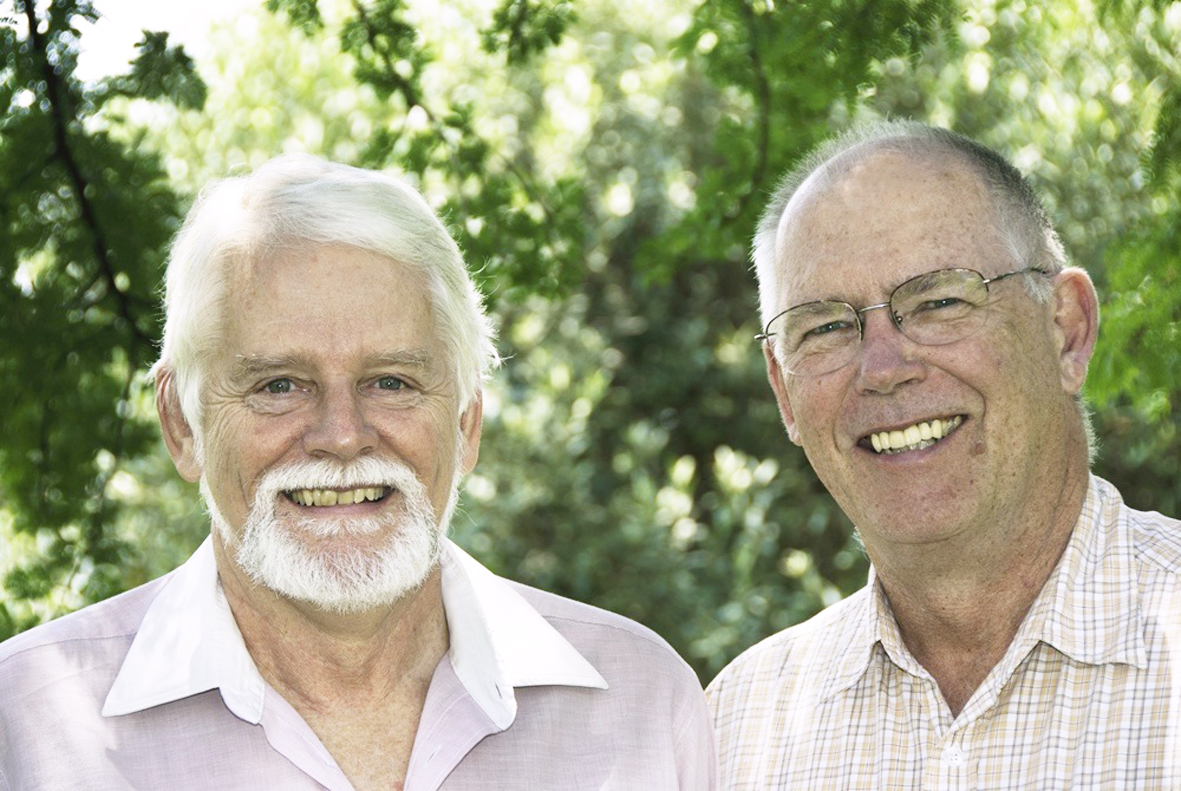
You can read the full Crime Fiction Lover review of Facets of Death here. In the meantime, here’s what the authors had to say when Crime Fiction Lover interviewer Sonja van der Westhuizen spoke to them…
First of all, what are crime fiction lovers going to love about Facets of Death?
Followers of Kubu will enjoy his backstory. In the contemporary books he seems very much in charge, looked up to, happily married. But that wasn’t always the case. He had a tough start and a lot of learning – both personally and professionally – to get there.
New readers will enjoy the thriller aspects. The crime is a huge and complex diamond heist from the richest mine in the world. Kubu and his boss, Assistant Superintendent Mabaku, deduce that it’s an inside job, and there’s a race against time to catch the culprits. That fails because the robbers are all killed by the South African police, and every time they feel they are getting closer, another murder takes place snapping the thread they’re following.
What made you decide to jump back in time and tell the origin story of this much-loved detective?
Kubu wasn’t supposed to be the protagonist of our first book, A Carrion Death. That was supposed to be the ecology professor who discovered the body. However, since it was clearly a murder, we needed a detective, and Kubu climbed into his Land Rover, fully formed and larger than life, and headed into the desert. Much to our surprise, after the first couple of chapters, he’d taken over the book! So there was actually a gap in his background for us, which was, in a way, also a gap in his character. We thought it would be fun for ourselves and our readers to fill that in. We know him better now.
Crime fiction across the world is often used to address social, economic and political issues. Do you think it’s important to address these issues in your novels?
All our novels have a contemporary southern African theme as the backstory. Blood diamonds, the plight of the Kalahari Bushmen, the growing Chinese influence, and so on. So, yes, we do think crime fiction can highlight these issues in a way that’s still gripping and entertaining.
Smuggling is a huge issue in this part of the world, and covers everything from cigarettes to drugs and rhino horn. Rhino-horn smuggling is something we feel very strongly about and our standalone thriller Dead of Night was motivated by that. The good side of the diamond mines is that Botswana benefitted substantially, and much of the money went into infrastructure and jobs for the local people. However, there were aspects of imperialism also.
Michael worked for the parent company of the diamond giant De Beers for ten years so has some insight into Botswana diamond mining.
In our interview with you a few years back you explained the mechanics of the writing process between the two of you. Have the lockdown conditions of the last year influenced your working methods while writing Facets of Death?
Since we always work together remotely, nothing much changed at the writing level. However, there was a big impact. For example, we always visit and spend time in the places we write about. We get different perspectives and ideas by doing that. When we’re there, we write a lot about the area. Most of that never finds its way into the book, but it makes us feel more comfortable with the setting, and we believe it gives the reader a better sense of place. In the book we’re writing now, we haven’t been able to do that because for much of the time the borders between South Africa and Botswana have been closed, and it’s caused us some issues. Hopefully, we’ll be able to correct that this year.
In crime fiction there is a tendency to classify books from geographical areas into sub-genres, such as Nordic noir. Do you think this is also applicable to African and, in particular, South African fiction?
For the most part, Nordic Noir represents a style of story-telling, a type of setting, more than it does where the writers come from. In general, African crime writing doesn’t exhibit a similar thread. The continent is too huge and too diverse for that.
Perhaps one exception is South African crime writing, which to a large extent has been inextricably tied to apartheid, either pre-democracy (The Kramer and Zondi series by James McClure) or post-democracy (Deon Meyer, Mike Nicol, and so on).
This is one reason why we set our stories in Botswana. There are so many issues facing southern Africa unrelated to apartheid that the only way to tell them was to leave South Africa. The same issues affect South Africa, but any book set in South Africa inevitably links back to apartheid.
African crime fiction has, tongue-in-cheek, been called Sunshine noir. What would you consider to be the characteristics of Sunshine noir?
For quite some time, writers from the Nordic countries have entertained us with their stories, as well as through the various TV and movie spin-offs. Part of the appeal, we suppose, is that there is predictability with respect to character and environment: relatively dour people wrapped up to keep out the cold!
In reality, the incidence of serious crime in these countries is very low. In Iceland, for example, there are more murders in one of Yrsa Sigurdardottir’s books than actual murders in a year in the country.
So we, also tongue-in-cheek, think that Nordic crime novels should be shelved under fantasy.
So where can we find a lot of nasty criminals? In hot places, of course. Cold never brings out the violence in people. Heat does. So Sunshine noir embraces crime in hot places, where the sun shines hot. As we say, the darkest shadows are where the sun shines brightest!
Why should international readers pick up a crime fiction novel set in Africa? What sets it apart and will attract readers to it?
The variety. There’s a whole continent here of different beliefs, cultures and landscapes, different environments and issues. Characters are shaped by all of these, and they give the reader a new perspective. Human nature is the same, of course. You’ll know how the detective thinks, but may be surprised by what he think about. In addition, readers may be surprised by both the differences and similarities in police procedures.
Apart from anything else, it’s a great way to travel, and there aren’t too many options right now!
Our readers might be familiar with the more well-known South African crime writers, but are there any new and upcoming South African – and African – crime writers we should be watching out for?
There certainly are, and some of them are very good! Sifiso Mzobe’s debut novel Young Blood won prizes in South Africa and is about to be released in the US for the first time.
Then there’s Kwei Quartey. He lives in Los Angeles, but his work is set in Ghana and he spends much time there. The first book in his new series, The Missing American, set in Accra with female PI, Emma Djan, has been shortlisted for the prestigious Edgar this year.
Or how about going to Nigeria to try Leye Adenle’s novels around a well-connected woman who makes it her business to look after for sex workers?
Back in South Africa, there’s Angela Makholwa with her dark comedies. The Black Widow Society says it all.


